The Hero’s Journey as a Map of Integration
If this is new territory for you, I urge you to pay attention.
Whenever ancient myths keep resurfacing in modern fiction—and continue to move millions of people—it’s a strong sign they are touching something deep and enduring in the human psyche.
Joseph Campbell mapped this territory in his classic work The Hero with a Thousand Faces. It isn’t always an easy read—long, dense, and full of mythic detours—but it offers a powerful bird’s-eye view of how stories from radically different cultures somehow echo the same underlying structure.
And that should make us curious.
Because whenever a pattern appears unconsciously across time and culture, it is almost certainly reflecting something within us.
Campbell noticed that in nearly every epic story ever told, a similar movement unfolds.
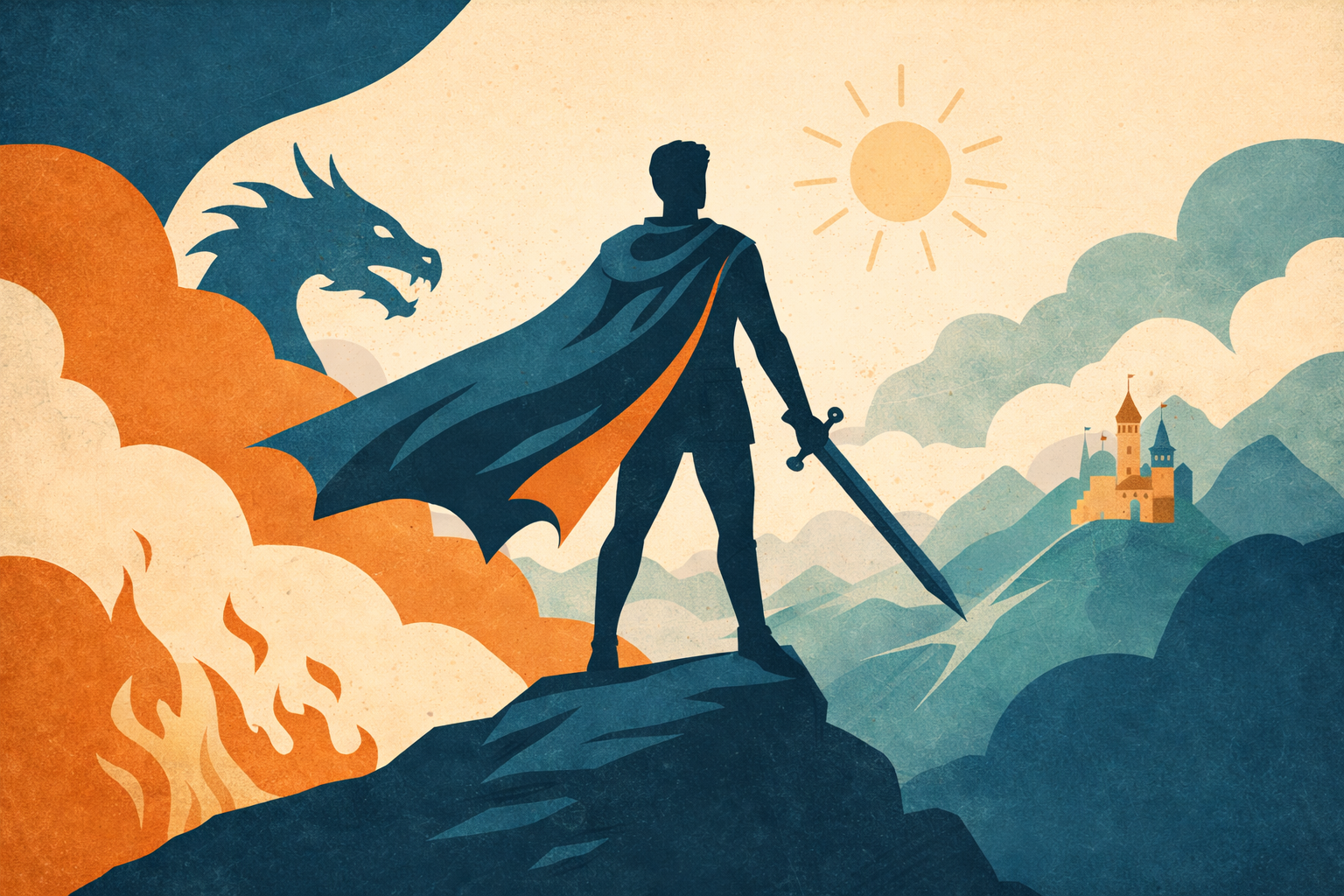
The hero—often an orphan or outsider (Luke Skywalker, Frodo Baggins, Harry Potter, Orpheus)—receives “the call to adventure.” A wider world opens up, but entering it requires a descent into the unknown: a journey into danger, chaos, and inner darkness.
This is not a sightseeing trip.
It is an initiation.
But it wasn’t only Campbell who mapped this territory.
The Jungian analyst Erich Neumann, in his formidable book The Origins and History of Consciousness, traced what the ambitious title suggests: the psychological evolution of humanity—and, by extension, the inner development of every individual. He describes how consciousness emerges, struggles, matures, and transforms over a lifetime.
If Campbell can be difficult at times, Neumann is like trying to read the Bible in a foreign language while slightly sleep-deprived.
Yet together, they form an extraordinary pair of lenses.
I like using both maps simultaneously, because they fill in each other’s gaps. Campbell gives us the outer journey—the mythic storyline. Neumann gives us the inner journey—the psychological architecture beneath it. And of course, outer and inner are ultimately one and the same.
In both versions, the pattern is clear:
The hero faces trials that push them to their limits. They meet allies and enemies, confront their fears, and wrestle with some form of inner or outer monster. If they survive, they return with “the treasure”—new wisdom, strength, or insight—something capable of blessing their community.
And here is the crucial point:
The journey is not complete until the treasure is integrated.
Insight without integration is just another fantasy. Growth only becomes real when it is woven back into ordinary life—into relationships, work, and community.
In mythic language, that is exactly what psychological integration looks like.
But Isn’t the Hero’s Journey for Men?
Oof. That’s a fair question.
And a complicated one.
It’s true: both Joseph Campbell and Erich Neumann were twentieth-century academic men, writing in a time and culture where “the hero” was assumed to be male. Their language reflects that era.
But that doesn’t automatically limit the usefulness of their ideas.
The Hero’s Journey, in my view, is not fundamentally about men. It is about consciousness itself. It describes a psychological process—separation, descent, confrontation, and return—that appears again and again in human experience, regardless of gender.
The fact that these models were articulated by men is largely historical. Comparative mythology and depth psychology were, for better or worse, fields dominated by male scholars at the time. That certainly introduces the possibility of bias.
But bias in authorship does not cancel explanatory power.
We should judge the model pragmatically:
Does it illuminate real psychological processes?
Does it map onto lived experience?
Does it help people understand their own inner journeys?
From what I’ve seen—across genders, cultures, and contexts—it does.
Maureen Murdock, a student of Campbell, recognised that something important was missing and articulated what she called The Heroine’s Journey. And she was right: the way this process unfolds will often look different in women than in men.
But it also looks different for people of every background, temperament, and life situation. No single map fits everyone perfectly.
There is another layer worth mentioning.
In depth-psychological language, “masculine” and “feminine” are not primarily about men and women. They are symbolic principles.
Masculine is often associated with consciousness, structure, differentiation, and the ego’s capacity to stand apart.
Feminine is often associated with the unconscious, relational depth, feeling, and the fertile ground from which consciousness emerges.
From this perspective, the Hero’s Journey is “masculine” only in this symbolic sense: it describes the differentiated ego venturing into the depths of the unconscious—the Great Mother, the feminine realm—to confront its origins and return transformed.
But the goal of the myth is not domination of the feminine.
It is union with it.
Jung called this the coniunctio—the sacred marriage of opposites.
Seen this way, the model moves far beyond gender politics. It becomes a description of how every human psyche—male or female—relates to its own inner world.
All of us have an ego.
All of us have an unconscious.
And all of us are called, in one way or another, to bring them into relationship.
The aim is integration, not polarisation.
So while the language of “hero” may sound masculine, the underlying journey belongs to anyone willing to do the work.
The Core Stages of the Hero Myth — As a Map for Integration
If we strip away dragons, spaceships, and magic rings, the Hero’s Journey is simply a psychological description of how people grow.
At its simplest, the map moves through three movements:
- Departure (The Call)
- Descent and Ordeal
- Return and Integration
Campbell described this as the outer narrative arc of myth.
Neumann described the same movement from the inside—as the ego separating from the unconscious, confronting it, and eventually learning to live in relationship with it.
Let’s translate that into real life.
1. The Call — Something in You Wakes Up
Integration rarely begins politely.
It usually starts as disruption:
A crisis.
A loss.
A dream that won’t leave you alone.
Burnout.
A psychedelic experience.
A quiet, persistent feeling that your life has become too small.
Psychologically, this is the unconscious knocking on the door of the ego.
Neumann would say the old identity can no longer contain the life trying to emerge.
Something in you realises:
I can’t keep living like this.
Refusal of the Call — The Part That Wants to Stay Asleep
Almost nobody greets that realisation with enthusiasm.
More often we:
Distract.
Numb.
Overwork.
Rationalise.
Pretend everything is fine.
Campbell called this the Refusal of the Call.
Neumann would say it is the ego clinging to familiar boundaries, terrified of being changed.
This resistance is not a failure.
It is part of the map.
Meeting the Guide
In myths, the hero rarely goes alone.
In life, guides look ordinary:
A therapist.
A book.
A mentor.
A dream.
A conversation that finally names what you’ve been feeling.
Integration almost never happens in isolation.
2. The Descent — Entering the Underworld
At some point you cross a threshold and can’t pretend anymore.
In real life this looks like:
Old grief resurfacing.
Anxiety spikes.
Identity confusion.
Pain you thought you’d outgrown.
Dreams getting louder.
This is the stage where people think:
I must be going backwards.
You’re not.
You’re going deeper.
Trials and Inner Monsters
The monsters in myth become very personal in integration:
Shame.
Abandonment.
Rage.
Unprocessed trauma.
Parts of you that were never allowed to speak.
Jung called this meeting the Shadow.
IFS calls them exiles and protectors.
Whatever the language, the experience is the same:
You meet yourself.
The Ordeal — Small Ego Deaths
Every journey has moments where the old identity collapses.
Realising a belief system no longer works.
Admitting you’ve built your life on pleasing others.
Letting go of who you thought you were.
Integration requires something false to fall apart so something truer can emerge.
3. The Return — Bringing the Treasure Home
This is where many spiritual approaches go wrong.
In myths, the hero does not stay in the underworld.
They return.
With something new:
Wisdom.
Boundaries.
Compassion.
A deeper sense of self.
Campbell is clear:
The journey is incomplete until the gift is woven back into ordinary life.
Neumann says the same psychologically: the ego must re-enter the world transformed, in relationship with the unconscious rather than ruled by it.
That is integration.
From Journey to Cycle — And What It Actually Looks Like
Where Campbell didn’t go far enough is in describing how this unfolds in real life.
The Hero’s Journey might more accurately be called the Hero’s Cycle.
You don’t descend once and come back forever changed.
You descend many times.
You meet old emotions that feel older than you.
You confront fears you thought you’d already overcome.
You lose your footing, regain it, and lose it again.
This happens through therapy, dreams, meditation, psychedelic work, journaling—anything that stirs the deeper layers of the psyche.
And you will almost certainly oscillate between engaging the unconscious and needing to rest from it.
But Campbell and the myths are right about something essential:
When you go through these cycles over time, a larger arc slowly begins to reveal itself.
Small descents accumulate into one broader descent.
Scattered insights connect.
A pattern emerges.
You begin to sense something like an “epic myth of your own life” taking shape beneath everyday events.
In that sense, myth is not fantasy at all.
It is a map—drawn from countless inner journeys—pointing back toward the terrain of our own.
But What Does This Actually Feel Like?
Here is the missing piece.
Myths are poetic.
Integration is messy.
The call usually arrives as:
a panic attack
a relationship crisis
a depression
a dream that won’t let go
the aching sense that your life no longer fits
The descent feels like:
confusion
anxiety
grief
strange dreams
feeling “not like yourself”
Disorientation is often the first sign that something real is happening.
The old structure of the self is loosening.
And loosening always feels like instability before it feels like freedom.
But what the monomyth ultimately teaches is conscious participation in your own story.
As you descend again and again—encountering strange inner terrain, memories, trauma, emotions, dragons, demons, angels, guides, and inner children—you slowly realise that every myth ever told is, in some sense, already inside you.
It has been your life all along.
You begin to read ancient stories, modern novels, and films and recognise yourself in all of them. The hero, the wanderer, the exile, the fool, the wounded one, the returning king—these are not just characters. They are living patterns within your own psyche.
That is integration:
not only of your personal history,
but of the larger human story moving through you.
A Final Word — The Ordinary Hero
If you strip away the fantasy language, the Hero’s Journey is not really about dragons, wizards, or magical kingdoms.
It is about becoming a more integrated human being.
The myths dress this up in shining armour and epic battles.
Life dresses it up in anxiety, conflict, crisis, and change.
Same journey.
Different costume.
Integration rarely looks heroic from the inside.
Most days it looks like:
choosing honesty over comfort
staying with a difficult emotion
setting a boundary you’ve been afraid to set
resting when you want to distract
asking for help instead of pretending you’re fine
returning, again and again, to what is real
These are small movements.
But they are exactly the movements that, over time, change a life.
So if you find yourself confused, unsettled, questioning, or in the middle of some private psychological storm—take heart.
You may simply be somewhere inside the cycle.
And the task is not to win.
It is to stay awake.
To keep listening.
To keep walking.
The treasure, more often than not, is nothing exotic at all.
It is the quiet experience of becoming a little more whole.
And that is heroic enough.