
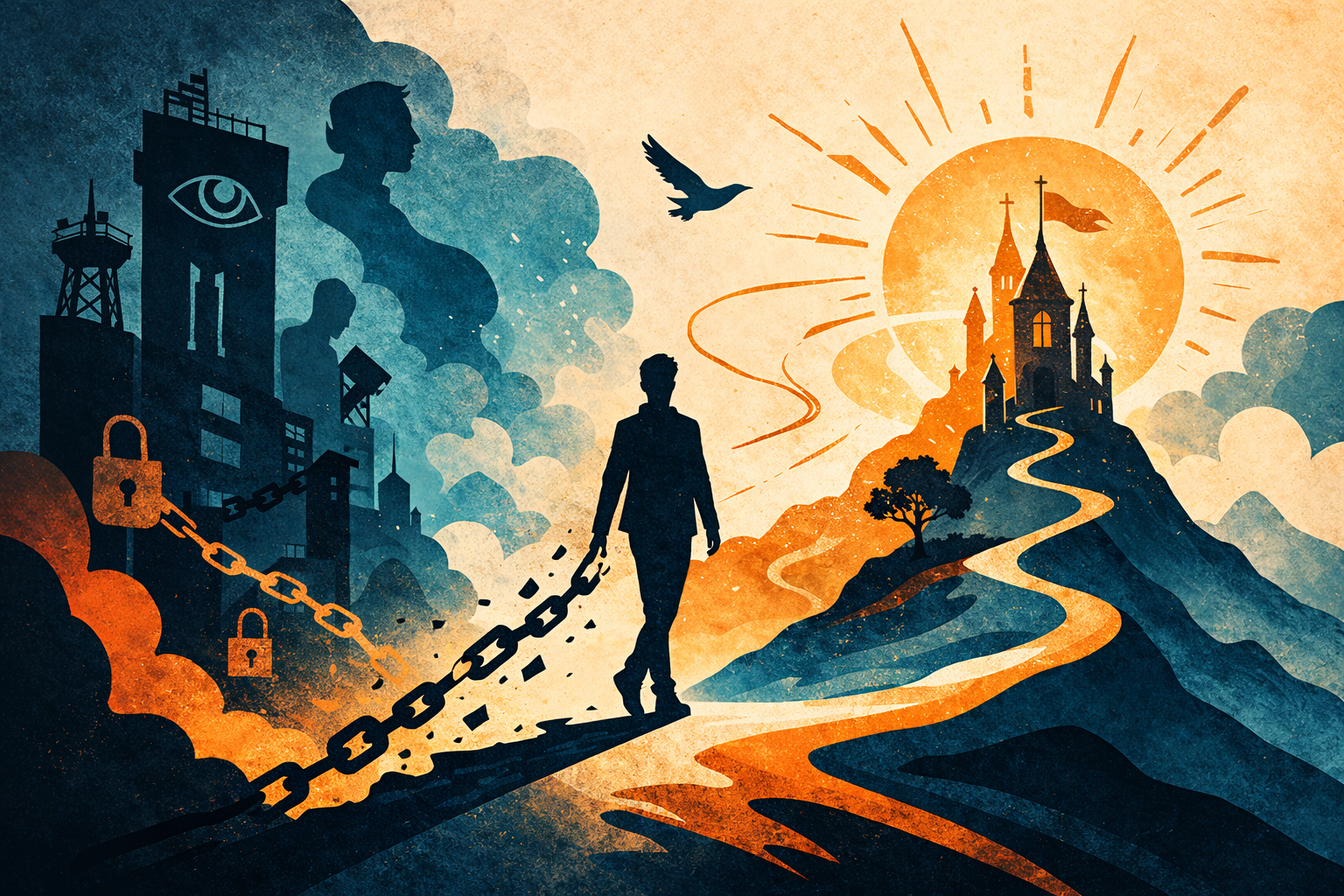
From External Authority to Inner Authority: The Development Nobody Prepared You For
One of the defining arcs of psychological adulthood is this: moving from being governed by external authority to being guided by an integrated inner one.
This transition is not a modern invention. It appears across myth, depth psychology, and developmental theory. It echoes through initiation rites, the philosophical tradition of self-examination, and contemplative paths that emphasise inner discernment over blind obedience.
Across cultures and centuries, the pattern repeats: authority begins outside the individual — and, if development proceeds, is gradually internalised.
But if you’re anything like me, you may not have realised how much authority you’d outsourced. I didn’t know what inner authority felt like. I even experienced the idea of it as slightly forbidden — almost indulgent.
And it raises a difficult question:
Are structures meant to shape the individual indefinitely — or to prepare them to stand on their own?
When is rebellion growth?
When is rebellion pathology?
When is obedience maturity?
When is obedience collapse?
How Reciprocity and Community Go Sideways
We romanticise sacred reciprocity. We tell stories of when the village stood together — when identity was shared, belonging was unquestioned, and hyper-individualism was inconceivable. There is a deep ache in those stories. A sense that something has been lost.
And perhaps something has.
Humans are not built for isolation. We are formed in relationship. We regulate through mutual recognition. Community is not an optional accessory to life — it is foundational.
But every form of belonging carries tension.
The same village that protects can also enforce.
The same shared meaning that binds can also exclude.
The same cohesion that nurtures can also resist change.
Over time, living reciprocity can solidify into structure. Structure can become identity. Identity can become preservation.
And when preservation becomes primary, growth becomes threatening.
What began as relationship becomes mechanism.
At that point, community is no longer a fluid exchange. It becomes a machine — and machines are not interested in individuation.
The Machine You Know (Yes, You Do)
Modern systems are extraordinarily effective at generating wealth and scale. But any entity structured around perpetual growth must prioritise its own survival. Even organisations that promise connection, healing, or “good vibes” are often dependent on attention and monetisation.
The image advertised is rarely “buy this product.”
It is: Join us and feel part of something.
Watch almost any commercial and notice how often belonging is the subtext. What is being offered is not merely utility — but identity. Not just a service — but a lifestyle.
High-control religious groups often use similar dynamics. “Love bombing” newcomers is not only kindness; it is onboarding. You are not simply adopting a worldview. You are entering a belonging structure.
This pattern is not confined to religion. Political movements can demand visible loyalty. Corporate cultures speak of family while optimising for performance. Even wellness communities are not immune — promising awakening while depending on subscriber growth.
Whenever growth, visibility, or cohesion become the central metric, development risks becoming secondary.
This is how it works: when growth becomes the primary metric, something subtle happens. The individual becomes both participant and product.
Community language is used.
Belonging is marketed.
Identity is reinforced.
But the deeper aim becomes the sustainability of the structure itself.
And when a system depends on your continued engagement, it is not incentivised to cultivate your inner authority. It is incentivised to keep you attached.
That’s not conspiracy.
It’s design.
In any system that depends on your attention, your attention becomes the commodity — and your dependence becomes the business model.
Over time, living inside optimisation systems changes us. We learn to measure ourselves the way the system measures value — by visibility, affirmation, alignment, engagement. Our centre of gravity shifts outward. Inner authority weakens. External metrics strengthen.
So in summary, something has gone wrong.
Reciprocity and community — once containers for development — have been absorbed into optimisation systems. What was meant to nourish growth now feeds scale, engagement, cohesion, retention.
Instead of supporting psychospiritual maturation, the machine consumes attention, loyalty, identity. It draws vitality from the very people it claims to serve.
And the more successful it becomes, the more it requires.
Belonging becomes performance.
Alignment becomes currency.
Doubt becomes risk.
This is not accidental.
It is structural.
Do you feel it?
The subtle emptiness it leaves behind.
The background anger humming beneath public discourse.
The exhaustion of endless positioning.
Can you feel how easy it is to be pulled into certainty — just to escape the tension?
If this diagnosis feels familiar, the solution is not withdrawal. It is not cynicism. It is not anti-community.
The task is to develop something that cannot be outsourced:
Inner authority.
Rebellion — When Enough Is Enough
We live in a culture that loves rebels — sometimes secretly, often very openly.
Robin Hood.
Tony Stark.
Harry Potter.
Jack Sparrow.
Shrek.
Katniss Everdeen.
Neo.
Ferris Bueller.
Bilbo Baggins.
Socrates.
Han Solo.
Rosa Parks.
Galileo.
The Mandalorian.
They are not side characters.
They are the story.
Without them, nothing moves. Nothing changes. Nothing awakens.
Would anyone watch a film where everyone politely conforms, the structure remains unquestioned, and nothing is challenged?
No.
Music pulses with the same archetype.
Slave songs. Spirituals. Jazz.
Rock and roll. Punk. Hip hop. Rap.
The greatest art has always carried defiance in its bloodstream.
It says what we are afraid to say.
It exposes what we are trained to ignore.
It gives voice to the tension building beneath the surface.
Every great story turns on the same moment:
Someone decides that enough is enough.
Enough illusion.
Enough corruption.
Enough hypocrisy.
Enough suffocation.
The rebel steps forward not because they crave chaos — but because the structure has drifted from life.
We romanticise them because they do what we hesitate to do.
They say no.
And that “no” restores something.
Robin Hood defies unjust taxation.
Harry Potter defies a corrupt Ministry.
Neo rejects the simulation.
Rosa Parks refuses humiliation.
Galileo questions dogma.
Bilbo leaves the Shire.
In every case, rebellion is not destruction for its own sake.
It is a refusal to let preservation outrank truth.
Stories become popular the same way ancient myths survived: repetition. Retelling. Resonance.
They condense something collective into narrative form.
Pop culture is not trivial.
It is contemporary mythology.
It tells us what is moving in the unconscious.
It reveals what we sense but cannot articulate.
It dramatises the tension between life and stagnation.
Prometheus steals fire from the gods.
Odin sacrifices himself for hidden knowledge.
Loki brings Ragnarok — the necessary collapse.
Gilgamesh goes beyond the edge and meets the limits of power.
Across cultures, the pattern repeats:
When structures harden and life is suffocated, rebellion becomes sacred.
Not because rebellion is inherently holy.
But because sometimes the only way to preserve what is living
is to disrupt what has become dead.
And How the Rebel is Outcast
But here’s the uncomfortable truth:
While in popular culture we adore the rebel — and are utterly lost without them —
in real life, we keep our distance.
We canonise them once the dust has settled.
We quote them once the risk has passed.
We build institutions in their name — often the very kind they disrupted.
But if we met them before the story resolved?
We would hesitate.
Read the Gospels carefully: Jesus is not safe.
He doesn’t “work within the system.” He exposes it.
“Woe to you, teachers of the law and Pharisees, you hypocrites!”
— Matthew 23
We celebrate him now — but would we have stood near him when the authorities closed in?
His own followers scattered.
We admire the Buddha’s awakening — but a prince abandoning his palace, wife, and child in search of truth would look reckless to most of us.
We love Bilbo’s adventure — but in real life we would probably advise him to stay in the Shire.
Be sensible.
Be realistic.
Don’t ruin a perfectly comfortable life chasing dragons.
Something in us prefers the structure to continue.
Even if it’s stale.
Even if it’s constricting.
Even if it’s quietly suffocating.
That’s why we blast punk rock in the car —
and then clock in on Monday morning.
We feel the defiance.
We taste the freedom.
And then we return to the machine.
Do you know why?
Because there are two voices.
One voice wants safety.
Belonging.
Predictability.
Approval.
The other wants truth.
Expansion.
Integrity.
Freedom.
“I can’t get involved! I’ve got work to do. It’s not that I like the Empire… I hate it. But there’s nothing I can do about it right now.”
— Luke Skywalker
That is not cowardice.
That is the voice of structure speaking.
One voice says: Stay aligned. Don’t risk it.
The other says: Enough.
The rebel lives in the tension between them.
And here is the part we don’t romanticise:
Most people silence the second voice.
The Rebel Within — Differentiation in Real Time
The capacity to rebel is not immaturity. In healthy development, it’s how you become a self.
We all come into the world utterly dependent. No other species arrives as unfinished as a human infant. A baby will do anything to keep the caregiver close — because closeness is survival. At first, there is a kind of psychological symbiosis: merging. Being held. Being mirrored. Being regulated from the outside.
But then something begins to happen.
A centre starts forming.
A no appears.
A preference.
A will.
A boundary.
This is not badness. This is the beginning of personhood.
And yet in many cultures — especially high-cohesion ones — emerging as an individual gets quietly pathologised: selfish, proud, independent, rebellious. Unity becomes the highest good, but what often gets sanctified as “unity” is actually conformity. Not communion, but compliance.
Even spiritual language can be used to short-circuit this arc:
“Lose yourself.”
“All is one.”
“Just serve the body.”
“Find yourself in God.”
“It’s all love, man.”
Now — these phrases can point to something real. There is a genuine mysticism here. But they can also become a bypass: a way to skip the hard, non-negotiable work of becoming differentiated.
Because here’s the uncomfortable truth:
If you don’t become a self, “surrender” isn’t surrender. It’s erasure.
It’s not spirituality. It’s compliance wearing sacred clothing.
And the rebel within you is often the first sign that your psyche refuses to disappear.
Here’s what most spiritual communities won’t say out loud:
If you never push back, you stay organised around other people’s expectations. You live by external permission. You remain loyal to “the way things are” — even when it quietly costs you your agency.
But most of the authority you’re rebelling against isn’t only external.
Over time, the mind internalises key figures and rules — what object relations calls internal objects. In plain language: we carry loaded versions of parents, communities, and moral authorities inside us. They don’t just live “out there.” They live in the nervous system.
That’s why leaving a system is never only a social act. It’s a psychological one.
“We…mistake our actual parents for the ideal patterns and potentials within us.”
— Robert Moore & Douglas Gillette
The moment you contemplate separation, the internalised authority responds — not with calm debate, but with sensation:
Guilt.
Fear.
Shame.
Dread.
Sometimes even nausea in the body.
Not because you’re weak.
Because your nervous system learned an equation early on:
alignment = safety
misalignment = danger
And the rebel is the part of you that starts to differentiate anyway.
This is the energy that gets pathologised — the “enough” energy. The boundary energy. The life-force that refuses to keep shrinking just to keep the peace. Untamed, it can look like reactivity. Integrated, it becomes backbone.
Because here’s the difference:
If you serve community out of fear — external fear or internalised fear — it may look like virtue, but it isn’t freedom. It’s survival strategy dressed up as spirituality.
Only when the inner rebel stands up — when the psyche takes agency, when the umbilical cord of compliance is finally cut — can community become voluntary. Reciprocity becomes real. Unity becomes chosen, not enforced.
In other words: if you never truly became yourself…
what, exactly, are you offering your community?
Integrating Rebel Energy Defines Inner Authority
Rebel energy is healthy. It’s the psyche’s No — the boundary force that refuses self-betrayal. But if it isn’t expressed, metabolised, and integrated, it doesn’t disappear.
It turns shadowy.
That’s why rebellion can calcify into a personality: permanent outrage, permanent opposition, permanent suspicion. The system becomes the scapegoat for everything. The rebel gets stuck — not because they’re “immature,” but because the energy never completed its developmental task.
Unintegrated rebel energy doesn’t create freedom. It creates compulsion.
Integrated rebel energy becomes something else entirely: clarity, backbone, discernment — and the ability to choose your life without needing permission.
Now the mythic pattern makes psychological sense.
In the Hero’s Journey, the rebel doesn’t remain a rebel. The rebel becomes the hero — because they reach the point where enough is enough, and they refuse to keep living a life that isn’t theirs.
But the hero isn’t just defiance. The hero is defiance that has matured into aim.
They pause. They reflect. They submit the fire to a deeper question:
What am I actually trying to protect?
What truth am I serving?
What is worth the cost?
That pause is the birth of inner authority: rebel energy disciplined by conscience.
The Inner Sovereign
Moore & Gillette put it bluntly: the Hero archetype helps the boy become a self — but the Hero must eventually “die” into humility, or it splits. One shadow is inflation (the Grandstander Bully). The other is collapse (the Coward). Inner authority is what comes after heroic possession: courage with limits.
Across myth, cinema, and developmental psychology, the trajectory repeats: separation, risk, ordeal — and the slow emergence of a self that can stand on its own feet.
The hero, in other words, is not the endpoint.
The hero is the vehicle — the part of you that fights for agency until something deeper can take the throne: the King / Queen — an organising centre, a principle of sovereignty.
Sovereignty is the part of you that can hold complexity, integrate the rebel without being possessed by it, and build a life ordered from the inside out.
Christianity sometimes calls this “the Christ within”: not only a figure you worship, but a principle that takes root in you — a new inner centre of authority. Read developmentally, it’s the movement from external governance to internal sovereignty: from borrowed righteousness to integrated conscience; from performance to love that doesn’t need applause.
And this arc is not unique to Christianity. Different traditions name the same developmental gravity in different ways:
Depth psychology speaks of an inner King/Queen: the organising centre that blesses, orders, and protects.
Attachment theory shows how a secure base begins external — and, if development goes well, becomes internalised.
The Stoics spoke of an “inner citadel”: a place in you that cannot be coerced.
Buddhism points toward awakening through direct seeing rather than inherited certainty.
Existentialists insist we must bear responsibility for our freedom instead of outsourcing it to systems.
Different metaphysics. Different language. But a recurring pattern: maturity is governed less by fear of disapproval and more by an inner axis that can hold ambiguity, act with clean boundaries, and serve something larger than ego.
Rebellion begins the arc.
Inner authority completes it.
Sovereign energy isn’t dominance. It’s centre. It’s the capacity to act without needing permission — and without needing applause.
When we identify with the King, we become tyrannical: controlling, inflated, self-prioritising.
When we disidentify too far, we become weak: dependent, hesitant, outsourcing agency to leaders and systems.
The work is to keep proper orbit: close enough to draw strength, far enough to stay humble.
The Sovereign serves a transpersonal good, protects the realm with clean boundaries, and blesses life by recognising what is real.
But In Real Life…
This all makes sense on paper — but what if it still feels like a stylish idea with no traction in your actual life?
Good. That means you’re not pretending.
Because if your psyche has never been organised by an inner blessing principle — only by an inner judge — then “inner authority” won’t feel familiar. It’ll feel suspicious. Indulgent. Unreal.
If the only voice that’s ever driven your life is an internalised authority — a copied rule-system running as survival software — sovereignty will sound like abstraction.
And if you’ve lived small long enough, you don’t just think small. Your body expects punishment for standing up.
So how do you recognise what you’ve never been allowed to feel?
If reading this makes you feel off — tight, guilty, watched — you may need more than rebel energy.
You may need sovereignty.
You might even glance over your shoulder, as if someone could catch you in the act.
The audacity of feeling your own power in ordinary life.
How indulgent.
How dangerous.
“Dare only to believe in yourselves — in yourselves and in your inward parts! He who doth not believe in himself always lieth.”
— Friedrich Nietzsche
So what builds inner authority in daily life — not as an aesthetic, but as a centre of gravity?
1) Widen the mind so it stops acting like a tyrant
Most people stay trapped in external authority for a simple reason: their mind becomes a closed system.
Same inputs. Same tribe. Same certainty loops.
So expand its territory.
Ten minutes a day: read one strong voice outside your worldview — not to replace your map, but to stop your map pretending it’s the whole world.
Then ask:
What’s the strongest point here?
Where is it brittle, blind, or inflated?
What do I keep (even 1%) for my own map?
That last question trains what most systems quietly punish:
choice.
Inner authority isn’t having the “correct” beliefs.
It’s becoming someone who can meet reality — and stay inside themselves.
2) Ground the body so you can actually hold your “No”
The hardest part of inner authority isn’t philosophical.
It’s physiological.
Because the moment you stand up, the old equation flares:
misalignment = danger
approval = safety
So you don’t just get thoughts. You get signals: tight chest, nausea, dread, shame, that watched feeling.
Don’t argue with it. Don’t shame it. Don’t “think positive.”
Do this:
Name it: “My body is in threat mode.”
Orient: let your eyes land on three neutral objects.
Press: feet into floor / back into chair.
Exhale longer than you inhale (3–4 rounds).
That’s it.
You’re teaching your nervous system the condition sovereignty requires:
I can disagree and remain safe.
I can separate and still survive.
I can hold my no without collapsing.
When your body can hold your no, your mind stops needing borrowed certainty.
3) Practice micro-sovereignty: one clean choice per day
Inner authority isn’t an identity. It’s a muscle.
So build it with reps.
Once per day, make one choice that is:
small enough to do today
clear enough to feel in your body
aligned enough that you respect yourself afterward
Not grand gestures. Not scorched earth.
One act of clean self-respect.
Examples:
say no without over-explaining
stop performing agreement
speak one honest sentence you usually swallow
do the thing you delay because someone might disapprove
choose what you actually want in a minor moment (food, timing, rest)
This is how sovereignty becomes real: a life built from chosen actions, not managed approval.
Conclusion
This is why inner authority matters beyond your private healing: it’s how cultures evolve.
A society cannot innovate its way out of crisis with people who outsource their conscience. The future will not be built by cronies, ideologues, or frightened conformists. It will be built by individuals who can hold complexity, stay centred under pressure, and act from an inner axis.
Individuation is not desertion from the collective.
It’s how the collective gets its best leaders back.
If you don’t become your own sovereign, you’ll pay anyway — either as jaded collapse or bitter inflation.
So you might as well try.
Because the machine doesn’t fear your rebellion.
It fears your sovereignty.