Why Did Looking at Clouds Feel Wrong?
I don’t normally hang around my patch of London.
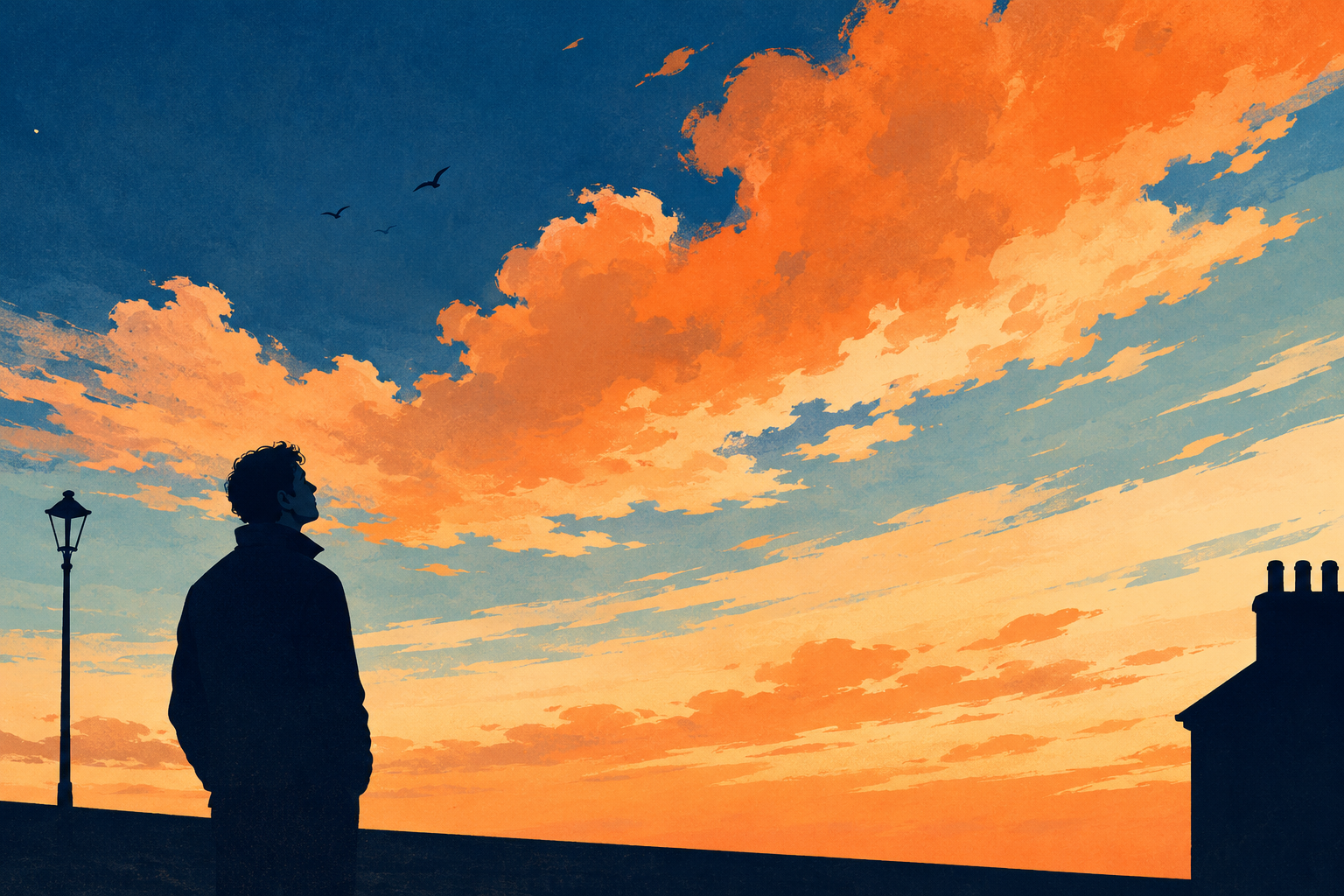
But I was outside a shop there on a late spring evening, waiting for someone, with nothing to do, when I noticed the sky. Creamy orange clouds against a still-blue sky. And I felt — for the first time in a while, because I’d been having a hard time — completely relaxed. Just standing there. Alive. Taking it in.
And then something clenched in my stomach.
People might think I’m weird. Because people who stand on the street staring up at the sky have something wrong with them. My hand was already moving toward my pocket, reaching for my phone, before I’d even finished the thought. A reflex. Give myself something to be doing. Become legible again.
I caught it mid-reach. And I asked myself a genuinely stupid-sounding question that turned out not to be stupid at all: standing outside enjoying the clouds is weird? Is that me thinking that, or would people actually think it? And — assuming they would — why on earth would it bother me? Why would anyone, anywhere, decide that a person looking at the sky is a person to be suspicious of?
Then I remembered the Underground.
Nobody on the Tube stares into space. Everybody is engaged — with a phone, a book, a podcast, the middle distance arranged to look like thought. We are all, at all times, visibly doing something. To sit on the Tube and simply look ahead, at nothing, doing nothing, is to become the slightly unnerving person other people clock and quietly file under off. Try it sometime and watch how fast you start to feel like a problem.
And then a word floated up that I’d never properly examined: loitering. We took doing-nothing-in-public and made it into something a police officer can move you along for. Loitering. Hanging around with no purpose. And notice — there’s no purpose, that’s the offence. Not theft, not damage, not noise. The crime is the absence of a reason.
Once you see it, you see it everywhere. Why are you in the park? Walking the dog. Why are you sitting on that bench? Waiting for someone. Why are you outside the shop looking up at the sky? Oh — I’m actually just checking my phone. We always have the reason ready. We hand it over like a passport. The one answer that’s quietly unacceptable, the one that makes people uneasy, is: no reason. I just wanted to.
So I’ll say the thing the cloud moment delivered to me, fully formed, on that street corner: doing nothing might be quietly stigmatised. Not banned. Not punished, mostly. Just — slightly shameful. Faintly suspect. Something you need a cover story for.
I should back up, though, because the clouds didn’t come out of nowhere.
I’d been having a hard time, and the specific shape of the hard time was this: I was procrastinating, badly, and it was eating me alive. Not because I wasn’t working — I was always sort of working — but because I was clinging to productivity like a life raft while simultaneously, comprehensively failing at it. It was the thing that mattered most to me and the thing I couldn’t do.
“And what’s wrong with doing nothing?” my therapist asked me, around that time. “Why don’t you try that?”
I genuinely couldn’t answer. The honest answer, which took me a while to find, was that doing nothing terrified me. So I procrastinated instead — which, when you actually look at it, is a beautiful compromise. Procrastination lets you not do the thing while still feeling busy, still feeling guilty, still feeling like a person with a to-do list, high stakes, and a story. You get to avoid the work and avoid the void. Everybody’s happy. Especially the part of me that could not, under any circumstances, just stand still.
Here’s what I think the procrastination was protecting me from. And it’s the same thing the clouds briefly stripped away.
I don’t think I’m actually wired to be productive. I think productivity is wired to keep me from noticing something.
Try it. Sit completely still, doing nothing, for any length of time — no phone, no plan, no breathing technique you can secretly score yourself on. The moment the activity stops, the feelings arrive. The nagging sense that something’s undone. The hunger with no object. The faint, low dread. I don’t keep busy because I love the things I’m busy with. I keep busy because the busyness works — it’s the most effective anaesthetic I’ve ever found, and I’ve been on it long enough to forget it’s a drug.
That’s the reframe that knocked me sideways. It isn’t that I need to be productive. It’s that productivity hides my own stuff from me so well I can’t see it anymore. The day I stop isn’t an empty day. It’s the day the bill comes.
Which brings me to my one sanctioned method of doing nothing: meditation.
I can do nothing, but only if I rebrand it. I cannot sit and watch my own thoughts drift past like clouds. But I can “meditate,” because meditation is productive. It lengthens your telomeres. It sharpens your memory. It lowers your cortisol. There’s research. There’s an app with a streak I don’t want to break. By the time I’ve finished assembling the business case, I’ve successfully tricked myself into ten minutes of doing nothing, and — this is the important part — I get to feel virtuous about it afterwards.
And look, don’t stop meditating. It works. But I’ve started to suspect this is the actual genius of the thing. The ancient con at the centre of it. Meditation is just sitting and watching the clouds, except inside your own head, dressed up as a discipline so that a frightened modern human can finally be tricked into doing nothing without panicking. It hands you a permission slip. You’re not loitering — you’re practising. The breath is your alibi.
Which is lovely. And also slightly horrifying. Because it means I can no longer reach presence directly. I have to launder it through a purpose. I need a reason to watch clouds.
And that’s where it finally landed — not where I’d expected.
What frightened me on that street corner wasn’t doing nothing. It was having no explanation for myself. The clench wasn’t really about the clouds, or even about looking weird. It was the specific terror of standing somewhere with no reason — unaccounted for, illegitimate. A phone would have fixed it instantly. So would a dog, a cigarette, a friend I was waiting for. Any of them would have made me legible. The clouds couldn’t, because clouds aren’t a reason. They’re just clouds.
That’s the thread running through it all. The phone gives me a reason to exist on that corner. Work gives me a reason to exist on a Tuesday. Meditation gives me a reason to sit still. Each one is a tiny certificate of legitimacy, and I collect them compulsively, and I’d never once noticed I was doing it — until the evening I stood somewhere with nothing to show, and felt my own body reach for an excuse.
And now I have to be honest about what this is.
This is roughly 2,000 words on the value of doing nothing. It is, itself, a thing I am doing. I have taken a moment of pure presence — clouds, sky, alive, no reason, nothing required of me — and I have converted it, with a fair amount of craft, into an essay. A deliverable. A productive output on the importance of not producing.
I noticed this about halfway through writing it, and I felt the clench again. The exact one from the street corner. Because of course I did this. Of course, the only way I could justify spending an evening thinking about that cloud was to make something out of it. I couldn’t just have had the moment and let it go. I had to file a report.
So the snake is eating its own tail, and I don’t think I can stop it, and I’m genuinely not sure I’d publish this if I could. That might be the most honest finding in here: I cannot tell you to go and do nothing without, in the telling, doing something. I needed permission to gaze at clouds — and writing this turns out to be me granting myself that permission, retroactively, in a currency the culture actually accepts.
I don’t have a clean ending, because I haven’t solved anything. I still reach for my phone. I still can’t lie down for twenty minutes on a Wednesday afternoon without feeling like a fugitive. I still meditate by lying to myself about why I’m doing it.
But I think I’ve found the real question, and it’s smaller and stranger than “Is society broken”—the grand, satisfying version I keep wanting to reach for but don’t quite trust. It’s this: why do I need a reason? Why can’t I just be somewhere, alive, wanting nothing, without an explanation prepared to give the second anyone asks?
I don’t know yet. What I can tell you is that at the street corner, I caught myself grasping for the phone, put it back in my pocket, and looked at the clouds for maybe another forty seconds before the discomfort won out, and I went into the shop.
Forty seconds. That was my limit, that evening, for being a person with no reason.
It’s a start. I’m choosing to count it.
Which, yes — I’m aware — is me turning even that into an achievement.
Old habits.